By Diana Dowdy, DNP, CNM, RDMS, FACNM
Welcome to WPOCUS Rapid Review, where we do the digging for you—bringing together relevant articles from national and international sources and turning them into fast-read, relatable evidence-based takeaways you can apply to your clinical practice.
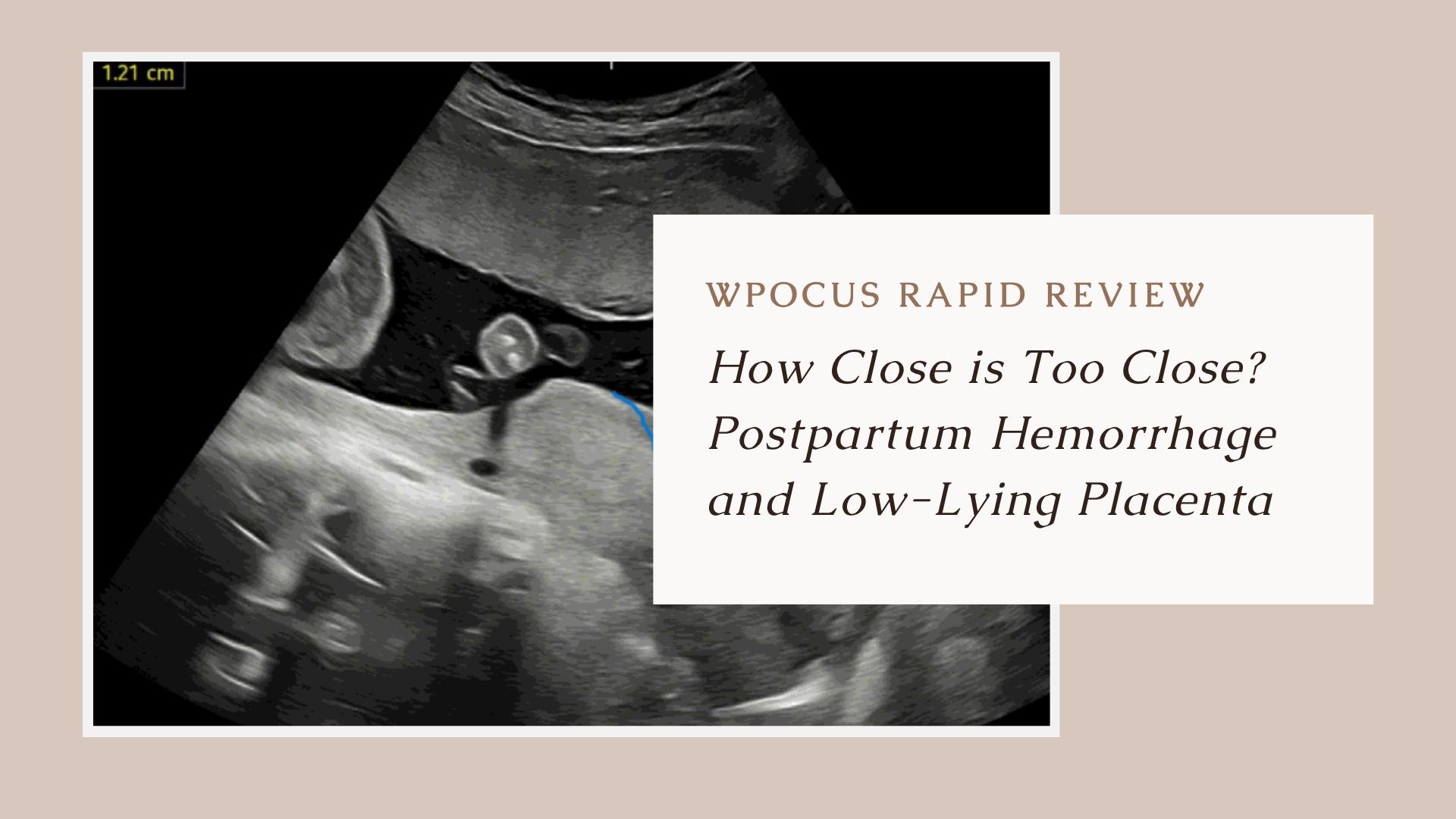
Let’s jump right in to the topic we’re scanning today: How Close is Too Close? Postpartum Hemorrhage and Low-lying Placenta
A low-lying placenta or previa is detected in mid-pregnancy. You follow its proximity to the cervix periodically until it appears to resolve. What is the “safe” distance to the cervical os, and even if the safe threshold is met, are there still risks?
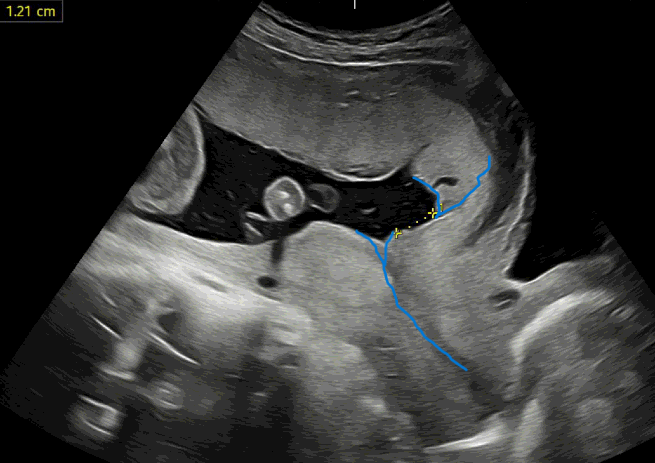 Low-lying placenta
What can affect the image and accurate diagnosis?
Incorrect orientation to the uterus (transverse rather than the correct sagittal)
Declaring a low-lying placenta or previa prior to 20 weeks gestation, when it is very likely not to be low-lying after 20 weeks
Failing to validate the measurement with a transvaginal view
Unclear view of the internal cervical os causing an incorrect measurement
Presence of a contraction that displaces the placenta toward or away from the cervix
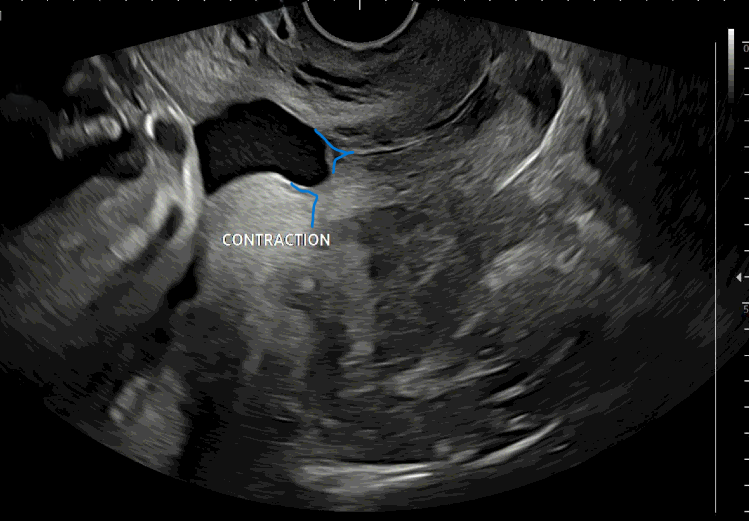 Uterine contraction pushes placenta, making it appear low-lying
About low-lying placentas
Placenta previa and low-lying placenta (LLP) occurs in up to 10% of pregnancies. (1) It is most often diagnosed or confirmed at the 20-week fetal anatomy scan.
Low-lying placenta is diagnosed by measuring the lowest placental edge to the internal cervical os (called the internal os distance, or IOD) measured on transvaginal ultrasound. Approximately 85-90% resolve by third trimester or term, with the ultimate incidence of 0.5% to 1.0%.
Providers often reassure women when the IOD is greater than 2.0 cm, when the placenta is no longer defined as low-lying. They may also lower their concern for postpartum hemorrhage (PPH) when considering delivery management.
But are there continued risks for women who have a resolved low-lying or placenta previa? And is the risk greater at less than 1.0 cm, or less than 2.0 cm? And is the risk gone if the IOD measures greater than 2.0 cm?
Two recent studies present another look at the continued risk of PPH even when the placenta retreats from the IOD threshold.
Kim, et al (2) published a retrospective matched-control cohort study including 447 women. For this study, the definition of LLP was 1.0 cm IOD and the definition of PPH was bleeding at delivery of >1000 cc.
Women with a resolved previa were 2.5 times more likely to experience PPH than controls (aOR 2.58, 95%CI 1.17-5.69). They also had a higher incidence of triage visits for bleeding, and peripartum iron infusion.
Bonnani,et al (3) published in December of 2025 a meta-analysis compiling the results of 21 studies, including 3704 women.
Diagnosis of low-lying placenta was associated with a twofold increased risk of PPH compared with women who had normal placenta location. The incidence of PPH was 16.6% in the 1–10 mm group, and 17.5% in the 11–20 mm low-lying placenta group (no statistically significant difference between these groups).
Compared with women who never had previa, those with resolved low-lying placenta or placenta previa remain at significantly higher risk for bleeding-related complications during pregnancy and delivery.
There is a need for vigilant monitoring and delivery management of pregnancies with low-lying placenta, even if it has resolved. Postpartum hemorrhage should be anticipated as a potential risk for resolved previas or LLPs, even if the placenta doesn’t meet the criteria for scheduling a C/Section (previa or IOD less than 1.0 cm)
REFERENCES
Cassardo O, Orsi M, Ossola M, Perugina G, Cetin I. Cesarian delivery for placenta previa. AJOG. 233(6), Supplement S255-S271, January 2026 https://www.ajog.org/article/S0002-9378(25)00662-3/fulltext
Kim S, Hamm R, Schwartz N. A resolved placenta previa is still associated with postpartum hemorrhage. Am J Perinatol. 2024 May 41(5 01): e928-3933. doi: 10.1055/a-1974-9399. Epub 2022 Nov 9.
Bonanni G, Lopez M, Tarchi S, Abiad M, Shantz C, Beflacqua E, et al. Systematic review of postpartum hemorrhage in patients with a low-lying placenta: A systematic review and meta-analysis. Obstetrics & Gynecology 146(6); 830-84, December 2025. DOI:10.1097/AOG.0000000000005956
Continue exploring with these related articles and insights
© 2026 WPOCUS Consulting, All Rights Reserved.