By WPOCUS Consulting

Welcome to WPOCUS Consulting: Why We Built a Different Kind of Ultrasound Education
For many women’s health providers, ultrasound has long felt both essential and inaccessible.
Not because clinicians lack the ability to learn it.
Not because ultrasound lacks value in practice.
But because the path to learning it has often felt overwhelming, impractical, or disconnected from the realities of patient care.
At WPOCUS Consulting, we believe women’s point-of-care ultrasound (POCUS) education should feel different.
It should be approachable.
Clinically relevant.
Grounded in competency and safety.
And designed for the way real providers actually practice.
That belief is what led to the creation of WPOCUS Consulting.
WPOCUS Consulting was founded in 2015 by Diana Dowdy after years of seeing both the value of ultrasound in women’s healthcare and the barriers preventing providers from learning it effectively.
Dr. Dowdy has practiced as a Certified Nurse-Midwife for more than 45 years and as a Registered Diagnostic Medical Sonographer for over 24 years. Her experience spans clinical practice, rural public health, academic education, curriculum development, and international women’s health initiatives.
But the foundation of WPOCUS Consulting did not begin in a classroom.
It began in patient care.
As a practicing women’s health provider, Dr. Dowdy repeatedly encountered situations where access to timely ultrasound could have changed a patient’s experience, clinical course, or decision-making process.
One experience in particular stayed with her.
A pregnant patient in her second trimester presented with bleeding late in the day before traveling to see her deployed husband. Without ultrasound access available in clinic, the patient was referred to the emergency department and waited overnight without being seen. She later miscarried while traveling.
For Dr. Dowdy, the issue was never about replacing comprehensive diagnostic imaging.
It was about recognizing that focused ultrasound, when appropriately trained and used within scope, could help clinicians make more timely assessments and improve access to care for women in real-world practice settings. [1,2]
Again and again, she saw patients waiting days for imaging, traveling long distances for simple assessments, or facing unnecessary delays when a focused point-of-care evaluation may have helped guide earlier clinical decisions.
Research across multiple clinical specialties has shown that point-of-care ultrasound can improve timeliness of bedside assessment and support clinical decision-making when integrated appropriately into workflow and supported by structured training programs. [4]
At the same time, she saw another problem emerging: many women’s health providers wanted ultrasound training, but existing educational models were not built for them.
Historically, ultrasound education has largely followed a sonography model: extensive technical training designed for comprehensive imaging specialists working within formal imaging departments.
That training is valuable and necessary.
But many women’s health providers were not seeking to become full-time sonographers. They needed practical skills relevant to focused clinical questions encountered during patient care.
Dr. Dowdy recognized that many existing programs were:
too advanced too early
heavily physics-focused
disconnected from workflow realities
centered around radiology-based practice models
not designed for busy clinicians balancing patient care responsibilities
Educational literature has also identified significant variability in ultrasound training pathways and growing demand for more integrated, clinically relevant educational models. [5,6]
Over the past decade, professional organizations including the American Institute of Ultrasound in Medicine (AIUM), the American College of Nurse-Midwives (ACNM), and the American Registry for Diagnostic Medical Sonography (ARDMS) have increasingly emphasized competency development, structured education, and clearly defined clinical scope for providers using focused ultrasound. [1,2,3]
Dr. Dowdy later served as Chair of the ARDMS Midwifery Ultrasound Exam Committee, helping shape competency standards for midwives performing ultrasound within defined clinical domains.
Those experiences helped shape the philosophy behind WPOCUS Consulting:
Women’s health providers deserve ultrasound education designed specifically for their clinical practice.
Most ultrasound education is designed to train sonographers.
WPOCUS Consulting was built to help women’s health providers confidently integrate focused ultrasound into clinical care.
That difference shapes everything about our curriculum.
We focus on the foundational skills that make the greatest difference in practice:
image acquisition
image optimization
recognizing normal anatomy
identifying common clinical findings
integrating ultrasound into clinical decision-making
understanding appropriate scope and limitations
Rather than overwhelming learners with advanced material immediately, our courses are designed to build competency progressively.
Educational research consistently suggests that competency develops most effectively through repeated exposure, supervised practice, structured feedback, and integration into real clinical workflows rather than isolated learning experiences. [5,6]
Healthcare providers are balancing patient care, administrative demands, documentation, and limited time for continuing education.
That reality matters.
Our curriculum is delivered in modular, self-paced online segments that allow learners to study foundational concepts on their own schedule before participating in hands-on training.
We also offer focused educational tracks for providers whose practice may center more specifically on:
gynecology
obstetrics
intrauterine device (IUD) management
entry-level women’s ultrasound applications
This allows learners to pursue education relevant to their actual patient population and workflow needs.
Ultrasound is not learned through slides alone.
Developing competency requires repetition, image review, guided feedback, and hands-on practice.
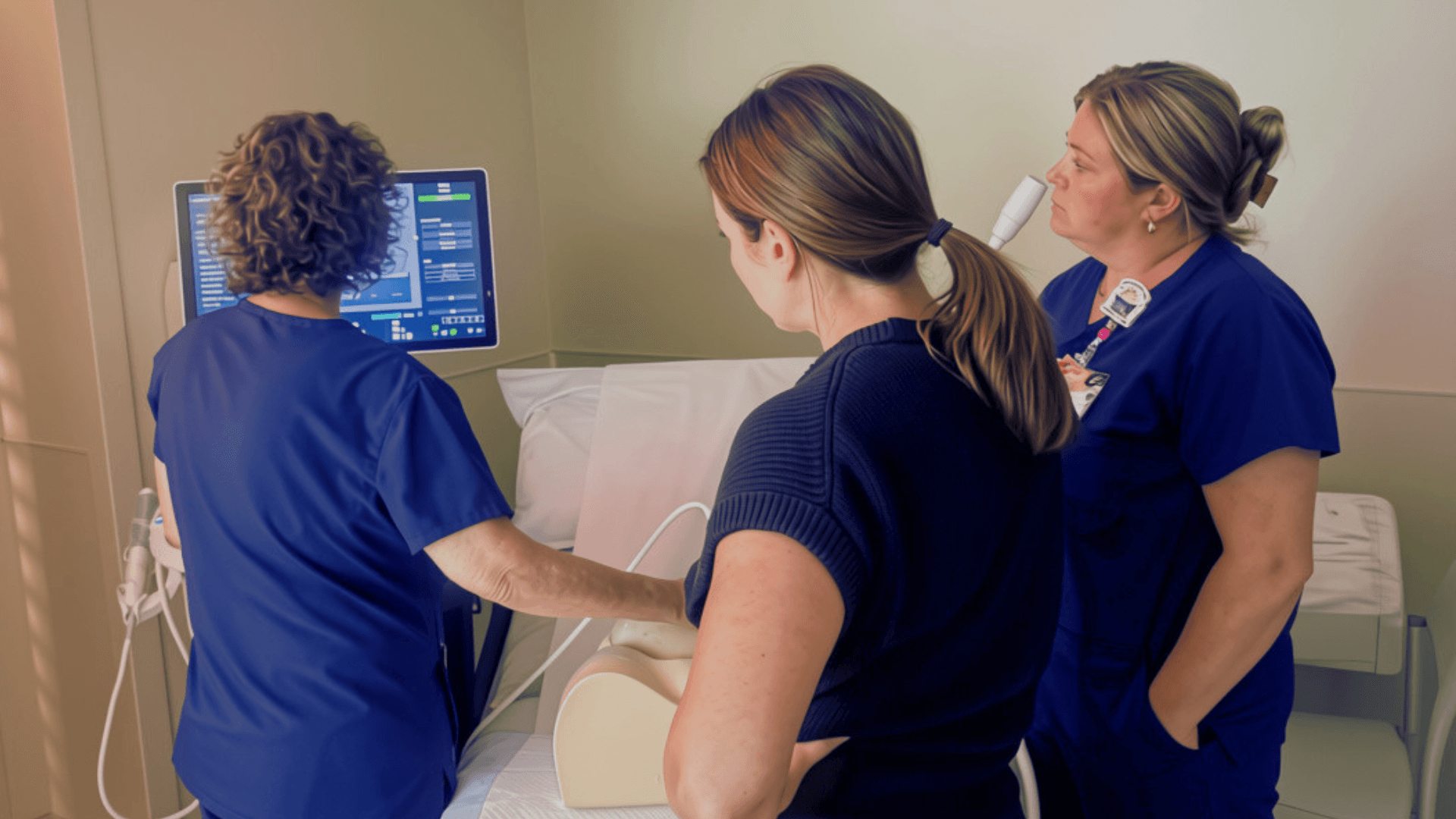
That is why our training combines online education with in-person skills sessions that include:
live scanning with models
small-group instruction
low learner-to-instructor ratios
image review and optimization feedback
hands-on practice with multiple ultrasound systems, including handheld devices
use of OB/GYN phantoms for procedural and anatomy learning
Studies evaluating ultrasound education programs have repeatedly demonstrated improved learner confidence and skill retention when didactic learning is paired with supervised hands-on scanning and feedback. [5,6]
Our goal is not simply course completion.
Our goal is helping clinicians develop practical confidence using ultrasound appropriately within their clinical environment.
One of the defining characteristics of WPOCUS Consulting is that our education is built by clinicians actively involved in women’s healthcare practice.
Dr. Dowdy continues part-time clinical practice in OB/GYN care while also teaching internationally and serving in academic roles focused on women’s health and ultrasound education.
Her work has included curriculum development and ultrasound education initiatives in Grenada, Kenya, and Uganda, where access to imaging resources may be limited and timely clinical assessment is especially important.
This combination of clinical practice, sonography expertise, curriculum development, and global health experience continues to shape the WPOCUS Consulting approach today.
For many clinicians, women’s POCUS is not about performing comprehensive diagnostic imaging.
It is about answering focused clinical questions safely and efficiently within scope. [1,2]
Examples may include:
confirming fetal presentation in labor
evaluating early pregnancy viability
assessing IUD placement
evaluating postpartum bleeding concerns
supporting triage decisions
improving access to care in underserved settings
When used appropriately, point-of-care ultrasound can support more timely clinical assessments while helping providers integrate imaging into patient-centered workflows. [4]
It is not a replacement for comprehensive imaging. [1]
But it can be an important extension of clinical assessment when supported by appropriate education, competency development, and clear practice standards. [1,2,3]
Women’s point-of-care ultrasound continues to evolve rapidly.
Portable systems are becoming more accessible. Clinical applications are expanding. More healthcare organizations are recognizing the role focused ultrasound can play in improving patient care and workflow efficiency.
But technology alone is not enough.
Education matters.
Standards matter.
Competency matters.
At WPOCUS Consulting, our mission remains the same as it was when this work began:
To make women’s point-of-care ultrasound more accessible, practical, and achievable for clinicians—without compromising safety, clinical integrity, or patient care.
WPOCUS Consulting was founded to address real clinical gaps in access to timely ultrasound care.
Our curriculum is designed specifically for women’s health providers using focused ultrasound in clinical practice.
We emphasize approachable, competency-focused education rather than overwhelming learners with unnecessary complexity.
Hands-on training, guided feedback, and practical workflow integration are central to our educational model.
WPOCUS Consulting supports clinicians seeking safe, practical implementation of ultrasound within women’s healthcare settings.
Whether you are new to ultrasound or looking to strengthen practical POCUS skills within women’s healthcare, our courses are designed to help clinicians build confidence through structured, clinically relevant education.
Explore current training opportunities through WPOCUS Consulting.
[1] American Institute of Ultrasound in Medicine (AIUM) Practice Parameters and Technical Standards
[2] American College of Nurse-Midwives (ACNM) Position Statement on Point-of-Care Ultrasound
[4] Moore CL, Copel JA. Point-of-Care Ultrasonography. New England Journal of Medicine. 2011
[6] Bahner DP, et al. The State of Ultrasound Education in U.S. Medical Schools. Academic Medicine. 2014
Continue exploring with these related articles and insights
© 2026 WPOCUS Consulting, All Rights Reserved.